
Too Many Systems. Not Enough Answers.
Too Many Systems. Not Enough Answers.
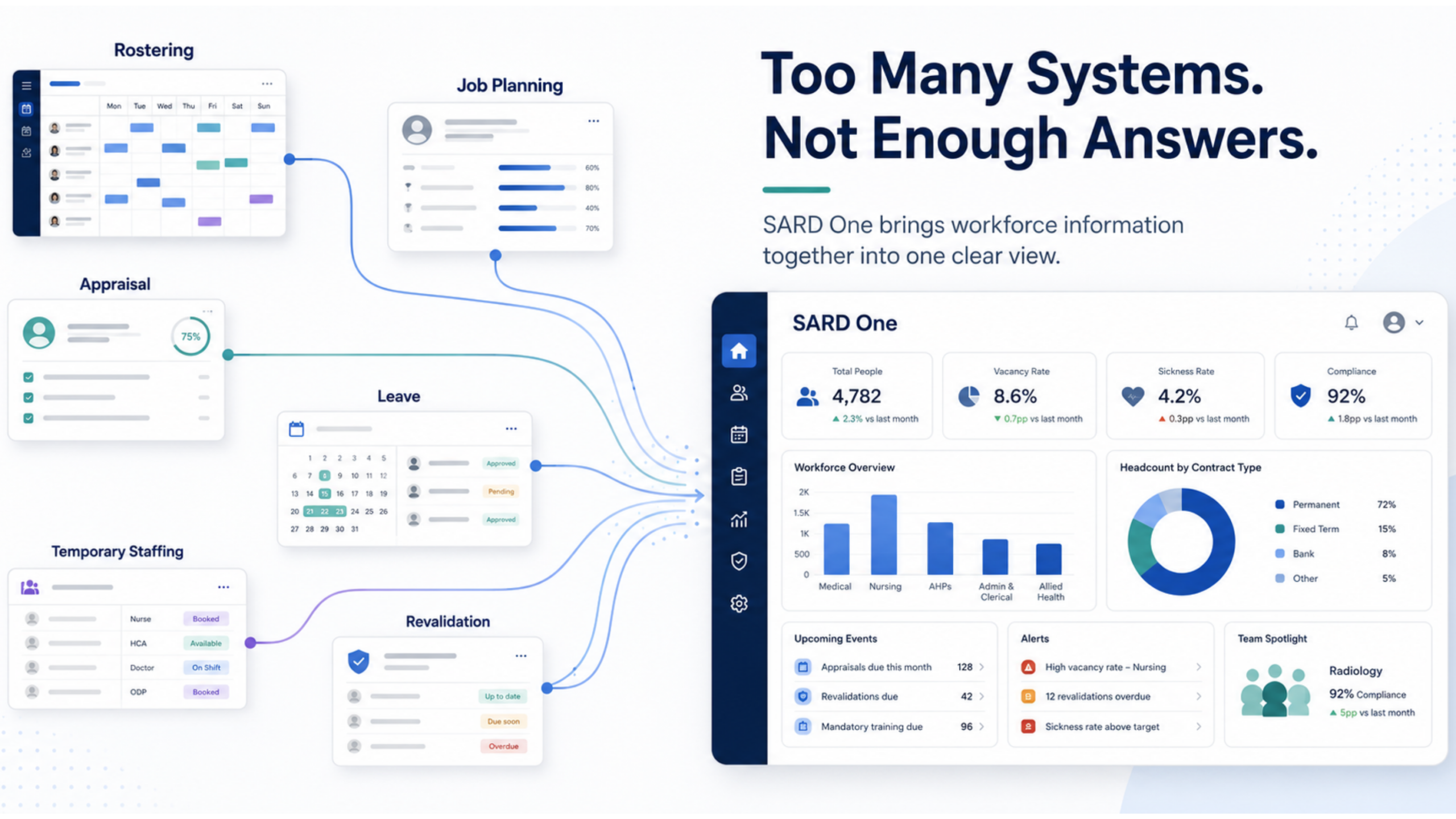
Visit almost any NHS trust and you will find a familiar picture. The cardiology team keeps its rota in one system. Anaesthetics use another. Nursing teams rely on something different altogether. Consultants manage their job plans in one place, leave requests somewhere else, and appraisal information somewhere else again. Along the way, systems appear. Then spreadsheets. Before long, valuable workforce information is scattered across multiple systems, departments and teams. Everyone is working hard and doing their best. Yet bringing together a clear picture of the workforce can feel far harder than it should.
For many workforce, medical staffing and operational teams, a simple question can turn into hours, days or weeks of work.
Q: Do we have enough clinical capacity to meet demand?
Q: Which doctors and nurses are due for appraisal?
Q: Where are we relying most heavily on temporary staffing?
Q: How is leave affecting service delivery?
Q: What is the quality of our job planning data?
The information exists. The challenge is that it is spread across multiple places with no single source of truth.
The Hidden Cost of Disconnected Workforce Systems
Most trusts have not deliberately created complexity. Different systems and processes have been adopted over many years because they solve specific problems well. One platform might be excellent for rostering. Another may be loved for how it handles appraisal and revalidation. A third may be perfect for how your team deals with temporary staffing. Each system performs its role. The difficulty comes when information needs to be brought together.
Workforce teams often find themselves exporting and downloading multiple reports, comparing spreadsheets, checking records manually and trying to reconcile different versions of the same information. Not because the data is unavailable, but because it is not connected. The more time people spend searching for information, the less time they can spend using it to make decisions that improve services, support staff and plan for the future.
Why Replacing Everything Isn’t the Answer
Organisations looking for a more joined-up view have often faced a difficult choice:
- Keep multiple systems and accept the complexity, or
- Try to replace everything with a single platform.
Neither option is particularly attractive and both have their limitations.
Many existing systems are well liked by the teams that use them. Staff know how they work and processes have been built around them. Replacing them can be costly, disruptive and time-consuming. At the same time, forcing every workforce function into a single platform can mean compromising on functionality somewhere along the way and ultimately, you’ll reach the edge of what these systems can do.
A Different Approach
Imagine being able to see workforce information from multiple systems in one place, without replacing the systems your teams already use. Imagine having a clearer understanding of capacity, compliance, leave, appraisal activity and workforce trends without manually pulling together reports from different sources. That is the challenge SARD One was created to address. Rather than asking trusts to abandon systems that already work, SARD One sits across them, bringing information together to create a more unified workforce view. The systems remain. The information becomes easier to use together.
Making Workforce Information Easier to Use
SARD One brings together information from multiple workforce systems into one place, so that NHS trusts can finally see a complete picture of their workforce. Instead of moving between platforms and manually reconciling reports, trust leaders can access connected information through a single experience.
The benefit is not simply convenience. It is greater confidence that:
- decisions are being made using the most complete information available
- trends can be identified earlier
- workforce planning reflects reality rather than assumptions
Better Visibility. Better Conversations.
When information is connected, conversations become more productive. Medical staffing teams can better understand how job plans align with service delivery. Clinical leaders can gain greater visibility of workforce pressures. Medical directors can access appraisal and revalidation information more easily. Workforce teams can spend less time producing reports and more time acting on them. The goal is not more data. The goal is making existing data accessible, useful and actionable.
Creating the Foundations for Workforce Transformation
Every trust is under pressure to do more with limited time and resources. What workforce leaders need is not more information, but clearer answers. The challenge is often not a lack of workforce data, but that too much of it sits in separate systems and processes. SARD One closes that gap by giving trusts a more complete view, without the need to replace the systems already in place. For many trusts, the missing piece is not another system. It is a way of making the existing ones work together.
SARD One is that missing piece.

Disclaimer: This information is provided for general guidance only. It may not reflect the most up-to-date NHS policies or local Trust practices. Always refer to current NHS guidance and your organisation’s policies for definitive information.




Registered address
SARD JV Limited
Unit 76, Innovation Centre
University Road, Canterbury
CT2 7FG


A joint venture with Oxleas NHS Foundation Trust.
Registered in England and Wales with company number 07916735. VAT No. 131901840
Designed and built By Tweak Marketing
Privacy Policy